What can an old scar tell us about headaches and digestion? Discover how German Auricular Medicine uses the ear and the body’s responses to investigate symptoms, uncover obstacles to recovery, and guide individualized treatment.
A woman came to see me recently with headaches and constipation.
Clinically, these two symptoms are often connected, and I had several reasonable places I could have started looking.
But her body pointed me somewhere else.
To an old scar on her neck.
Now, her body didn’t actually say, “Batya, check my neck.”
But our bodies communicate information all the time that we aren’t consciously aware of.
Our nervous systems are constantly taking in information, processing it and responding, often before that information ever reaches our conscious awareness.
Your heart rate can change. Your breathing can shift. Blood vessels can constrict or dilate.
And sometimes we can use those physiological responses as information.
That’s one of the ideas behind German Auricular Medicine (GAM), a specialized form of acupuncture that helps me investigate what may be contributing to someone’s symptoms.
What is German Auricular Medicine?
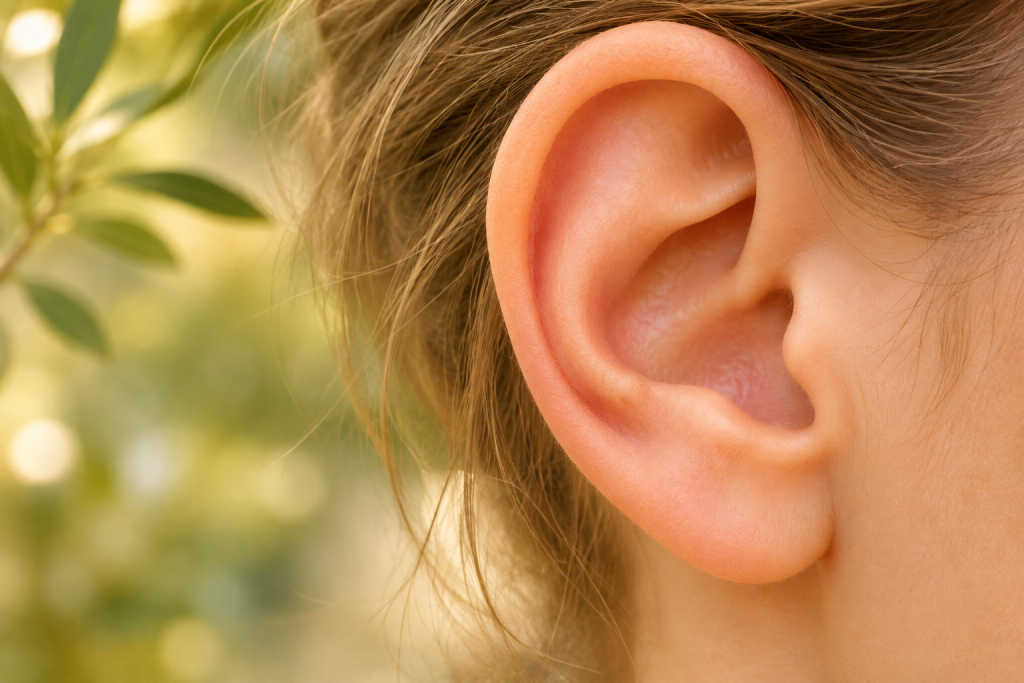
Developed from the work of French physician Dr. Paul Nogier and expanded by German physicians, including Dr. Frank Bahr, GAM uses the ear as a map of the body.
The whole body is represented on the ear, from the spine, muscles and internal organs to areas associated with the brain and nervous system.
You may have seen one of those strange-looking ear acupuncture charts covered in tiny points.
But in German Auricular Medicine, that map isn’t static.
I don’t simply find the shoulder point and treat it because your shoulder hurts.
The ear doesn’t just show me where you hurt. It helps me investigate why.
And that’s where the pulse comes in.
What can your pulse tell us?
One of the distinctive features of GAM is the Vascular Autonomic Signal (VAS).
It’s a momentary change in the strength of the pulse, usually lasting about three beats, that I can feel under my fingers.
When I’m holding your wrist during treatment, I’m not counting your pulse. I’m feeling for that response.
I can introduce different stimuli, perhaps testing a point on the ear or moving a specialized tool over an area of the body, and observe whether there’s a VAS response.
That’s how the woman’s scar became something worth investigating.
She didn’t know it was relevant. I didn’t know it was relevant. But I felt a response when I tested it.
And that gave me a direction for treatment.
And in this woman’s case? We’re still treating her, but both her headaches and digestion have been steadily improving.
What might be getting in the way?
One of the first things I investigate in German Auricular Medicine is whether something is interfering with the body’s ability to respond to treatment.
We call these blockages or interference fields.
These might involve an old scar, a problematic tooth, an area of inflammation, a previous infection, or even an emotional trauma.
And they may seem completely unrelated to the problem we’re trying to treat.
This is particularly important when someone has already tried conventional medical treatments that should have helped, but hasn’t experienced the expected improvement.
Sometimes the question isn’t simply what treatment someone needs. It’s what’s preventing their body from responding to treatment in the first place.
That’s why identifying and addressing blockages is one of my first priorities. I want to give the treatment we choose the best possible chance of working.
What if several things are contributing?
Sometimes the hardest part of having a health problem isn’t finding a possible explanation.
It’s knowing which explanation to believe.
I recently treated a woman with widespread aches and joint pain.
Her doctor had raised the possibility of fibromyalgia. Her gynecologist thought the pain might be related to menopause and changes in estrogen.
Those are two different ways of understanding the same symptoms.
So I wanted to know:
What seemed to matter most?
Using the VAS and specific focus points, I investigated not only what might be contributing to her symptoms, but also which findings seemed most important.
Several things appeared relevant, including an emotional component and the joint pain itself. But estrogen regulation stood out as the dominant finding.
So that’s where I started.
Prioritizing doesn’t mean treating only one thing. It means knowing which thing matters most.
And that can change what happens next, from the acupuncture points and herbal treatment I choose to what else a patient may want to investigate.
From investigation to treatment
I generally combine German Auricular Medicine with traditional Chinese acupuncture, Chinese herbal medicine and other approaches.
I may use fine acupuncture needles or a specialized therapeutic laser to stimulate points on the ear or body.
I also use different laser pulsing frequencies, both to investigate how a patient responds and as part of treatment.
And I reassess, because the findings may change as treatment progresses.
The goal isn’t to give everyone with the same diagnosis the same treatment. It’s to understand what’s happening in this particular person and what deserves attention now.
Sometimes the answer is exactly where we’d expect. And sometimes it isn’t.
The diagnosis tells us what you’re experiencing. It doesn’t necessarily tell us why it’s happening.
And the more we understand, the better we can tailor treatment to you.
If you’re dealing with a health problem, whether it’s something straightforward or something you’ve been struggling with for years, I’d be happy to help you explore what’s going on.